Taping Over New Paint: When Is It Actually Safe?
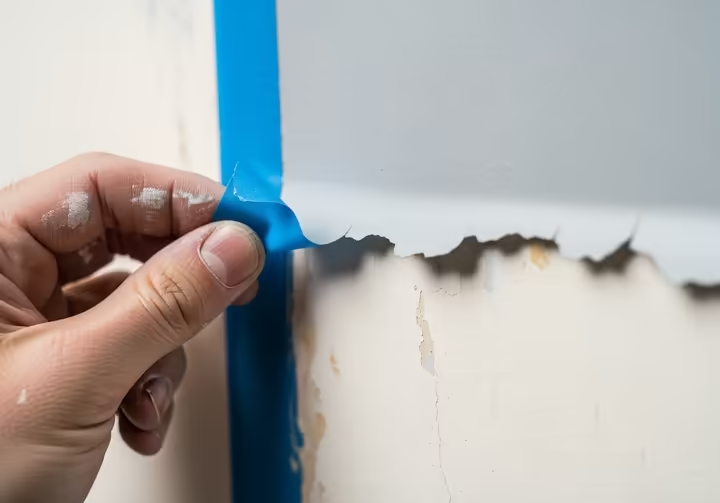
You just painted a wall. You waited for it to feel dry. You applied painter's tape for that crisp accent line... and when you peeled it off, huge sheets of your new paint came with it. This happens because of a common mix-up between paint that is "dry" and paint that is fully "cured."
Don't Be Fooled: The Difference Between Dry and Cured
So what does "dry" even mean? It's just a physical process, the paint's solvent evaporating. For most modern paints (water-based latex or acrylic), that solvent is water. 1, 3
As the water leaves, the surface loses its stickiness and becomes "dry to the touch," which can happen in an hour or two. 1 For old-school oil-based paints, the solvent is mineral spirits, and this step takes longer, maybe six to eight hours. 3
But this dry feeling is a trap. It makes you think the paint is ready for tape, but the film underneath is still weak. Even the "recoat time" on the can just means you can add another coat without making a mess, not that the paint is strong enough for tape. 1
Curing, on the other hand, is a long chemical process. The paint's binders, polymers and resins, react to form a hard, solid film. 2 This is what gives paint its final strength and makes it scrubbable.
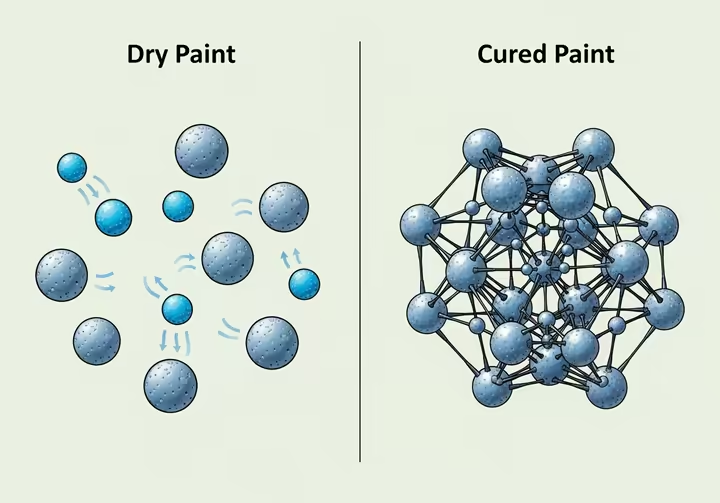
You can't judge curing by touch. A latex paint might feel dry in an hour, but it can take 21 to 30 days to fully cure. 1 Oil-based paints often cure faster, hitting max hardness in about seven days. 1
If you put tape on paint that is only dry, not cured, the tape's adhesive can form a stronger bond with the soft paint than the paint has with the wall. When you pull the tape, it rips the delicate film apart.
What Affects Curing Time?
How long it takes for paint to fully cure isn't a single number. It depends on the paint's formula, its sheen, the room's conditions, and how thickly you applied it. Understanding these factors helps you guess your project's timeline and avoid taping too soon.
Paint Types: It's What's Inside the Can
Most paint you use indoors is water-based (latex or acrylic). First, the water evaporates, squishing all the tiny polymer particles together. Then, those particles fuse into a solid film, a process called coalescence. 4
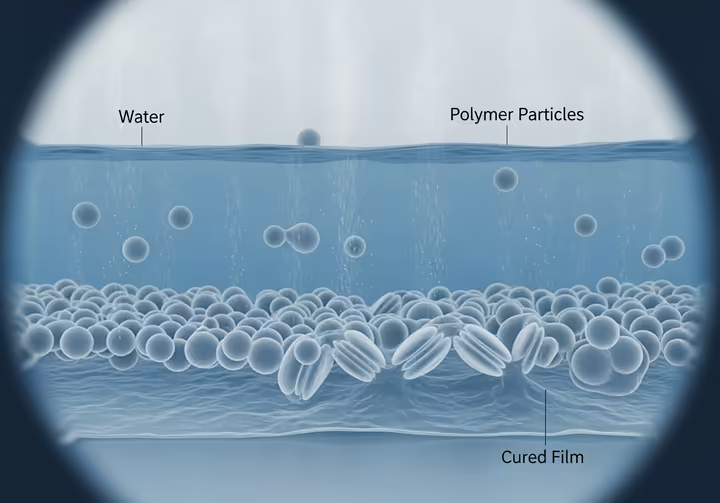
But even then it's not strong. The final stage, chemical cross-linking, takes the longest. Polymer chains form strong bonds with each other, creating a tough 3D network that gives the paint its durability. 7
Oil-based (alkyd) paints cure in a completely different way called autoxidative polymerization. 10 It’s a chemical reaction with the air. The drying oils in the paint, like linseed oil, react with oxygen and cross-link to form a hard film. 12, 13, 15
This reaction is sped up by metal-based driers (like cobalt or manganese). 12 Fun fact: because they absorb oxygen from the air, oil-based paints actually gain a tiny bit of weight as they cure. 12
New hybrid paints (waterborne alkyds) try to give you the best of both worlds, the hard finish of oils with the easy cleanup of acrylics. 17 They dry in two stages, first water evaporates like a latex paint, then the alkyd resins cure through oxidation. 19 This still means they can take a full 30 days to get rock hard. 20
Oh, and "enamel"? It used to mean a tough oil-based paint, but now it's just a word for any paint that dries to an extra-hard, durable finish, whether it's oil or water-based. 21
Shiny vs. Dull: How Sheen Changes Things
A paint's sheen, from flat to high-gloss, is both an aesthetic choice and a direct indicator of its chemistry, affecting its cure time. Sheen is all about the ratio of pigment (the color particles) to binder (the glue that holds it all together). 23
Matte and flat paints have lots of pigment and not much binder. This creates a rough texture that scatters light and hides imperfections. 23 As you go up to eggshell, satin, and gloss, the amount of binder increases, creating a smoother, more reflective, and more durable surface. 23
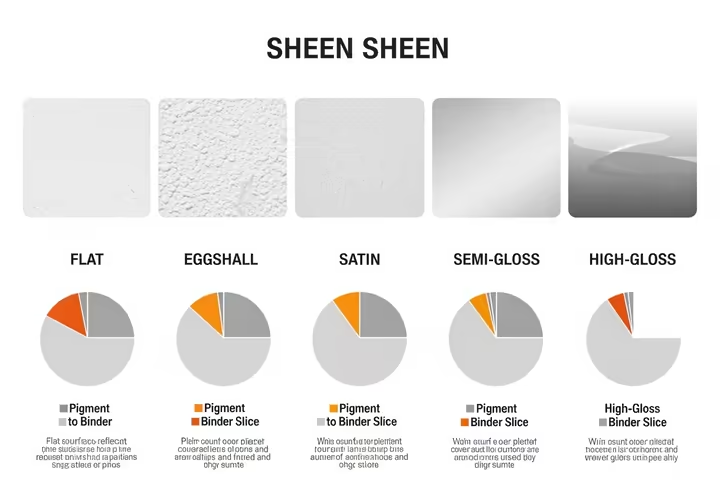
More binder means a longer cure time. 25 There's simply more stuff that needs to chemically cross-link. These resin-rich surfaces are also more prone to "blocking", which is when two painted surfaces stick together (like a door to its frame). 26, 27 Tape can cause a similar effect, bonding tightly to the soft, uncured surface of a glossy paint.
Watch the Weather: Humidity, Heat, and Airflow
The room itself has a huge say in how fast your paint cures. Temperature, humidity, and airflow can change your timeline dramatically.
For water-based paints, humidity is your number one enemy. If the air is already full of water, the water in your paint has nowhere to go, slowing evaporation to a crawl. 3 The ideal humidity is 40-50%; anything over 85% is a bad idea. 25
Temperature matters too, since curing is a chemical reaction. Cold temperatures (below 50°F or 10°C) can stop the process completely. 4 Super high temps can also be a problem, causing the surface to "skin over," trapping solvents underneath. 30 The sweet spot is usually between 70°F and 77°F (21°C and 25°C). 25
A gentle breeze from a fan can help whisk away evaporated solvent, speeding up the initial drying. 3 But don't point a fan directly at the wall, it can cause that "skinning over" problem we just talked about.
Don't Slap It On: Why Thin Coats Are Better
A thick coat of paint will take way, way longer to cure than a thin one. 3 This is because paint has to dry from the outside in.
If you apply a super thick coat, the surface dries and forms a skin, trapping the solvent underneath. 33 The paint below can't properly cure and stays soft, sometimes forever. 35
When you put tape on this compromised surface, you're not just pulling paint off the wall. You're peeling that cured top "skin" right off the mushy paint underneath, which is why it comes off in big sheets.
Not All Tape is Created Equal
A good taping job needs both properly cured paint and the right tape. Tapes come with different levels of stickiness (adhesion) for different jobs. Using the wrong one is asking for trouble.
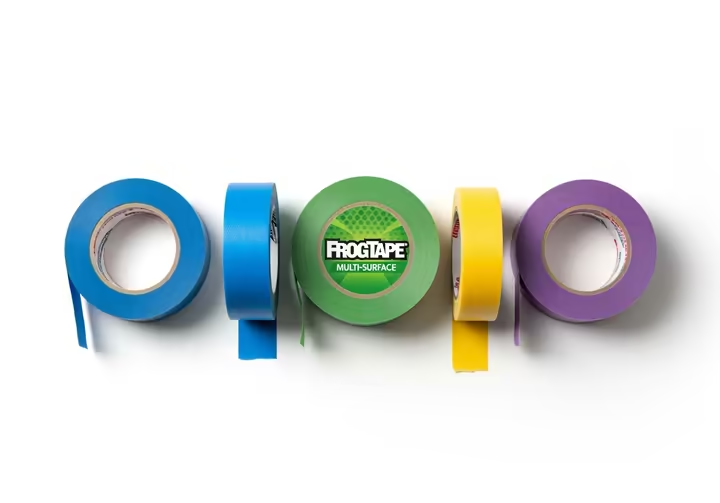
Standard blue or green painter's tapes are medium-adhesion, good for cured drywall or wood trim. 37 For more sensitive jobs, you need delicate-surface tape. These tapes (often purple, yellow, or white) have a lower-tack adhesive perfect for freshly painted walls (after 24 hours), wallpaper, or faux finishes. 38, 41
Some tapes have fancy tech. FrogTape, for example, has PaintBlock® Technology. 43 Its edges are treated with a polymer that reacts with the water in latex paint. 45 When wet paint hits it, the polymer instantly gels and forms a tiny dam, sealing the edge of the tape to stop paint from bleeding underneath. 45, 47
So, How Long Should I Actually Wait?
There's no single magic number for how long to wait, you have to play detective with your specific project. Start with a conservative baseline, adjust for your situation, and then do a physical test.
For a best-case scenario (a thin coat of latex paint in a climate-controlled room), wait a minimum of 24 to 72 hours. 49 And even then, you must use a low-adhesion, delicate-surface tape. That's the absolute minimum.
A low-risk project might be painting a living room with a matte-finish paint in a dry, stable home. Here, 24-72 hours is probably fine. A high-risk project would be painting a humid bathroom with dark, semi-gloss enamel in cool weather. In that case, you should wait much longer, probably 7 to 10 days, maybe more.
The Fingernail Test
The best tool you have is your own fingernail. Find a hidden spot, like inside a closet or behind where a sofa will go. Press your nail firmly into the paint. 1
If the surface is hard and your nail doesn't leave a mark, the paint is probably cured enough for tape. 1 If it feels soft or rubbery, or if you leave a dent, stop! The paint is not ready. Applying tape now will almost certainly cause damage. 1
The Big Pull: How to Remove Tape Without Wrecking Your Work
Perfect timing and technique aren't enough. You have to remove the tape correctly, too.
The best time to remove tape is in the "golden window", when the last coat of paint is dry to the touch but not fully cured. This is usually within a few hours of application. 49 At this stage, the paint film is flexible enough to stretch and break cleanly at the tape line.
If you wait too long (weeks), the paint becomes a hard, brittle "bridge" over the tape. 53 When you pull the tape, the paint can crack in a jagged line or pull up paint from the wall.
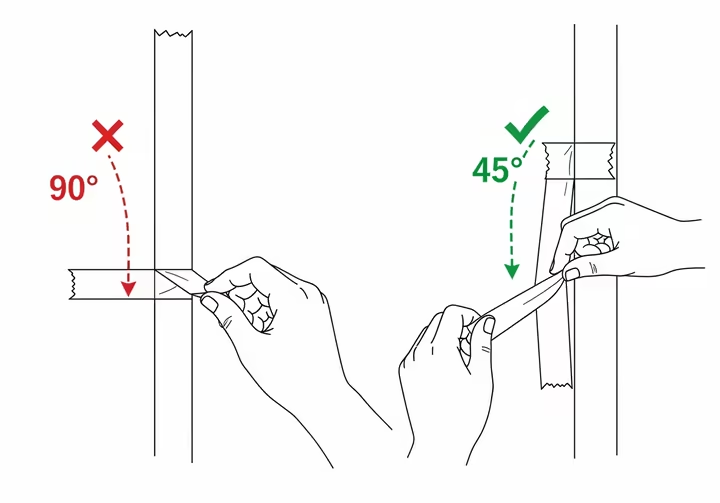
Pull the tape slowly, back on itself, at a sharp 45-degree angle. 55 This angle helps slice the paint film cleanly. Pulling straight out (at 90 degrees) puts more stress on the paint and makes it more likely to peel.
Emergency Repairs
If paint starts to lift, stop pulling immediately. Use a sharp utility knife or razor blade to gently score the paint along the edge of the tape. 55 This creates a clean break where the paint failed to make one itself.
After scoring, you can resume pulling the tape away slowly at that 45-degree angle. You can also try gently warming the tape with a hairdryer on a low setting to soften the adhesive, but be careful not to overheat and damage the fresh paint. 57
Works cited
- Paint Dry and Paint Cure... Two Totally Different Things & A Lesson In Patience - Salvaged Inspirations, https://salvagedinspirations.com/paint-dry-and-paint-cure/
- Paint curing: what it is and testing methods - Industrial Physics, https://industrialphysics.com/knowledgebase/articles/paint-curing/
- How Long Does Paint Take to Dry & Cure - Glidden, https://www.glidden.com/advice/how-long-does-paint-take-to-dry-cure
- Latex Paint Drying Time Vs Curing Time - Westlake Interior Painting, https://westlakeinteriorpainting.com/latex-paint-drying-time-vs-curing-time/
- ELI5: What's happening to a paint when it "cures" after drying? : explainlikeimfive - Reddit, https://www.reddit.com/r/explainlikeimfive/comments/1bfbhxe/eli5_whats_happening_to_a_paint_when_it_cures/
- TECHNICAL BULLETIN - Dry Time Versus Cure ... - Dunn-Edwards, https://www.dunnedwards.com/wp-content/uploads/2021/06/TB_Dry_Time_versus_Cure_Time_of_Paint.pdf
- WO2008001764A1 - Latex composition containing crosslinking agent and crosslinked molded body thereof - Google Patents, https://patents.google.com/patent/WO2008001764A1/en
- Formation and Crosslinking of Latex Films through the Reaction of ..., https://www.paint.org/wp-content/uploads/2021/09/jctJUNE98-Winnik.pdf
- Water-Resistant Latex Coatings: Tuning of Properties by Polymerizable Surfactant, Covalent Crosslinking and Nanostructured ZnO Additive - MDPI, https://www.mdpi.com/2079-6412/11/3/347
- Oil Paint Drying Process - Dartecor, https://www.dartecor.com/post/oil-paint-drying-process
- How do oil paints dry? : r/askscience - Reddit, https://www.reddit.com/r/askscience/comments/5vlxe5/how_do_oil_paints_dry/
- Oil Paints: The Chemistry of Drying Oils and the Potential for Solvent ..., https://repository.si.edu/server/api/core/bitstreams/99593f43-8cff-4a9e-be8f-e8dec85255bc/content
- Comprehensive Characterization of Drying Oil Oxidation and Polymerization Using Time-Resolved Infrared Spectroscopy - PMC, https://pmc.ncbi.nlm.nih.gov/articles/PMC11394013/
- Comprehensive Characterization of Drying Oil Oxidation and Polymerization Using Time-Resolved Infrared Spectroscopy | Macromolecules - ACS Publications, https://pubs.acs.org/doi/10.1021/acs.macromol.4c01164
- ELI5: How does oil-based paint dry? Does the oil evaporate, or does it contain water that evaporates? : r/explainlikeimfive - Reddit, https://www.reddit.com/r/explainlikeimfive/comments/39dks6/eli5_how_does_oilbased_paint_dry_does_the_oil/
- Oil Paint Drying Times: Why Do Some Pigments Dry Faster? - Painting Best Practices, https://paintingbestpractices.com/oil-paint-drying-times-why-do-some-pigments-dry-faster/
- CN102746762B - Alkyd acrylic acid hybrid latex paint and preparation method thereof - Google Patents, https://patents.google.com/patent/CN102746762B/en
- Everything You Need to Know About Alkyd Paint, https://www.roepaint.com/blog/everything-need-know-alkyd-paint
- Near-Zero-VOC-Waterborne-Alkyd-Dispersions_June-2016.pdf, https://www.paint.org/wp-content/uploads/2021/09/Near-Zero-VOC-Waterborne-Alkyd-Dispersions_June-2016.pdf
- ProClassic® Interior Waterbased Acrylic-Alkyd Semi ... - paintdocs.com, https://www.paintdocs.com/docs/webPDF.jsp?SITEID=STORECAT&lang=E&doctype=PDS&prodno=650153679
- Can someone explain different types of paints? Latex, acrylic, enamel, lacquer and any other different kinds. - Reddit, https://www.reddit.com/r/HomeImprovement/comments/gkmy2m/can_someone_explain_different_types_of_paints/
- How Long Does Paint Take to Dry? - Barker-Whittle, https://www.barker-whittle.com.au/blog/how-long-does-paint-take-to-dry
- Paint sheen - Wikipedia, https://en.wikipedia.org/wiki/Paint_sheen
- Paint Sheens 101: How To Choose The Right Finish - DIY Playbook, https://thediyplaybook.com/paint-sheens-101/
- How Long Should You Wait Between Coats of Paint? - The Spruce, https://www.thespruce.com/wait-between-coats-of-paint-4770225
- www.ppgpaints.com, https://www.ppgpaints.com/pro/pro-painting-tips/how-to-fix-paint-blocking#:~:text=Paint%20blocking%20is%20a%20common,adheres%20to%20the%20other%20surface.
- Paint Sticking or Blocking | Contractors | Benjamin Moore, https://www.benjaminmoore.com/en-us/contractors/job-solutions/troubleshooting/paint-sticking
- Understanding the Impact of High Humidity on Painting Projects - JMA Painters, https://jmapainters.com/understanding-the-impact-of-high-humidity-on-painting-projects/
- How Temperature & Humidity Impact Cure - Astro Chemical, https://astrochemical.com/how-temperature-and-humidity-impact-cure/
- The Science Behind Paint: How Humidity and Temperature Affect Drying Times, https://www.thevillepaintingco.com/post/the-science-behind-paint-how-humidity-and-temperature-affect-drying-times
- Wet Film Thickness (WFT) - GARDCO, https://www.gardco.com/wet-film-thickness
- Understanding Wet Film Thickness (WFT) and Dry Film Thickness (DFT) - EAH Industrial Spray Equipment & Coatings Inc., https://www.eahindustrial.com/blog/understanding-wet-film-thickness-wft-and-dry-film-thickness-dft-/
- Solvent Popping | PPG Global, https://uk.ppgrefinish.com/en/paint-defects/solvent-popping/
- The "Whoas" of Solvent Entrapment and Release - KTA-Tator, Inc., https://kta.com/whoas-solvent-entrapment/
- Pinhole and Gas Trapping - KANSAI ALTAN, https://www.kansaialtan.com.tr/pinhole-and-gas-trapping
- Overcoming Paint Film Defects: Causes and Remedies - UL Prospector, https://www.ulprospector.com/knowledge/6636/pc-overcoming-paint-film-defects-causes-remedies/
- What's the Best Painter's Tape? | Five Star Painting, https://www.fivestarpainting.com/blog/2018/august/blue-tape-vs-green-tape-whats-the-best-painters-/
- Painter's Tape Colors: What They Indicate About Usage and Surfaces - Trimaco, https://trimaco.com/blog/painters-tape-colors-what-they-indicate-about-usage-and-surfaces/
- FrogTape® Pro Grade Painter's Tape, https://www.frogtape.com/products/pro-grade-painters-tape
- Understanding Delicate Painters Tape: A Professional's Guide-KEYSUN _Masking Product Manufactory, https://www.keysuntape.com/news_de/1950028553620766720.html
- When should I use a delicate surface painter's tape? - Tape University®, https://tapeuniversity.com/industry/paint-industry/when-should-i-use-a-delicate-surface-painters-tape/
- Types of Painters Tape for Delicate Surfaces, https://www.painterssolutions.com/blogs/painters-news/types-of-painters-tape-for-delicate-surfaces
- FrogTape® PaintBlock® Technology - YouTube, https://www.youtube.com/watch?v=bDVRFFJV1AI
- FrogTape® Multi-Surface Painter's Tape | FrogTape, https://www.frogtape.com/products/multi-surface-painters-tape
- FrogTape® Lab Series: PaintBlock® Technology - YouTube, https://www.youtube.com/watch?v=nL4aad2ZGXM
- Why FROGTAPE is the Best Painter's Tape for Crisp Lines, https://www.lightmenpainting.com/blog/frog-tape
- How FrogTape works. #simple #tape @frogtape - YouTube, https://www.youtube.com/shorts/sOB1lg3Ev20
- Why Frogtape, https://frogtape.eu/en/why-frogtape/
- Get Answers to Questions | Scotch® Painter's Tape, https://www.scotchblue.com/3M/en_US/scotchblue/your-questions/
- How Soon Can I Tape After Painting? - PPC, https://swppc.com/2017/12/06/how-soon-can-i-tape-after-painting/
- Fingernail Test - Corrosionpedia, https://www.corrosionpedia.com/definition/5541/fingernail-test-coatings
- The IMPORTANT Fingernail Scratch Test - YouTube, https://www.youtube.com/watch?v=aehbSQlkxrg
- When and How to Remove Painter's Tape - The Spruce, https://www.thespruce.com/when-to-remove-painters-tape-1822387
- How long to leave painter's tape on after painting? Let's find out, https://www.ppmindustries.com/en/news/how-long-to-leave-painter-s-tape-on-after-painting-let-s-find-out
- www.scotchblue.com, https://www.scotchblue.com/3M/en_US/scotchblue/proper-tape-removal/#:~:text=Use%20a%20putty%20knife%20or,cracking%20along%20the%20paint%20line.&text=Taking%20your%20time%2C%20lift%20up,at%20a%2045%20degree%20angle.
- How to Remove Painter's Tape | Scotch® Painter's Tape, https://www.scotchblue.com/3M/en_US/scotchblue/proper-tape-removal/
- painting - How do I prevent masking tape on paintwork from pulling ..., https://diy.stackexchange.com/questions/3133/how-do-i-prevent-masking-tape-on-paintwork-from-pulling-off-paint
- How to Remove Stubborn Masking Tape - YouTube, https://www.youtube.com/watch?v=4xeK3Nmn9o8